


Why Your Gut Controls Your Hormones
⚡ Quick Answer
Gut health directly influences hormone balance through the estrobolome, a group of gut bacteria that regulate how estrogen is metabolized and cleared. When the microbiome is disrupted, estrogen recirculates in the bloodstream instead of being eliminated, triggering symptoms like bloating, mood swings, fatigue, and weight changes even when standard lab work appears completely normal. Acupuncture, Chinese herbal medicine, and functional medicine address these root causes naturally.
Key Takeaways
- Your gut microbiome directly controls how estrogen is processed and eliminated.
- An imbalanced gut causes estrogen to recirculate, driving symptoms like PMS, weight gain, mood changes, and fatigue.
- Standard lab tests often miss these imbalances and normal results do not mean your body is functioning optimally.
- Inflammation, poor detoxification, and intestinal permeability are root causes that go undetected on standard panels.
- Acupuncture, Chinese herbal medicine, and functional medicine can restore gut-hormone balance naturally.
Women across Long Island and Suffolk County are finding relief by addressing the gut-hormone connection.
Hormone imbalance is one of the most common concerns I see in my practice, and what strikes me most is how many women are doing everything right and still not feeling like themselves.
They are eating well, managing stress, staying active, and following every recommendation they’ve been given. And yet, they’re still dealing with bloating, fatigue, mood swings, stubborn weight changes, irregular cycles, poor sleep, or that quiet but persistent sense that something is off.
Many have already had their labs done and been told everything looks normal. But they don’t feel normal.
This is usually the moment where we stop looking at hormones in isolation and start asking a different question: What systems in the body could be influencing this pattern? More often than not, the answer leads us back to the gut.
Once you begin to understand how deeply gut health is connected to hormone regulation, inflammation, and overall balance, then the pieces to the puzzle come together in a way that finally makes sense.
What Is the Connection Between Gut Health and Hormone Balance?
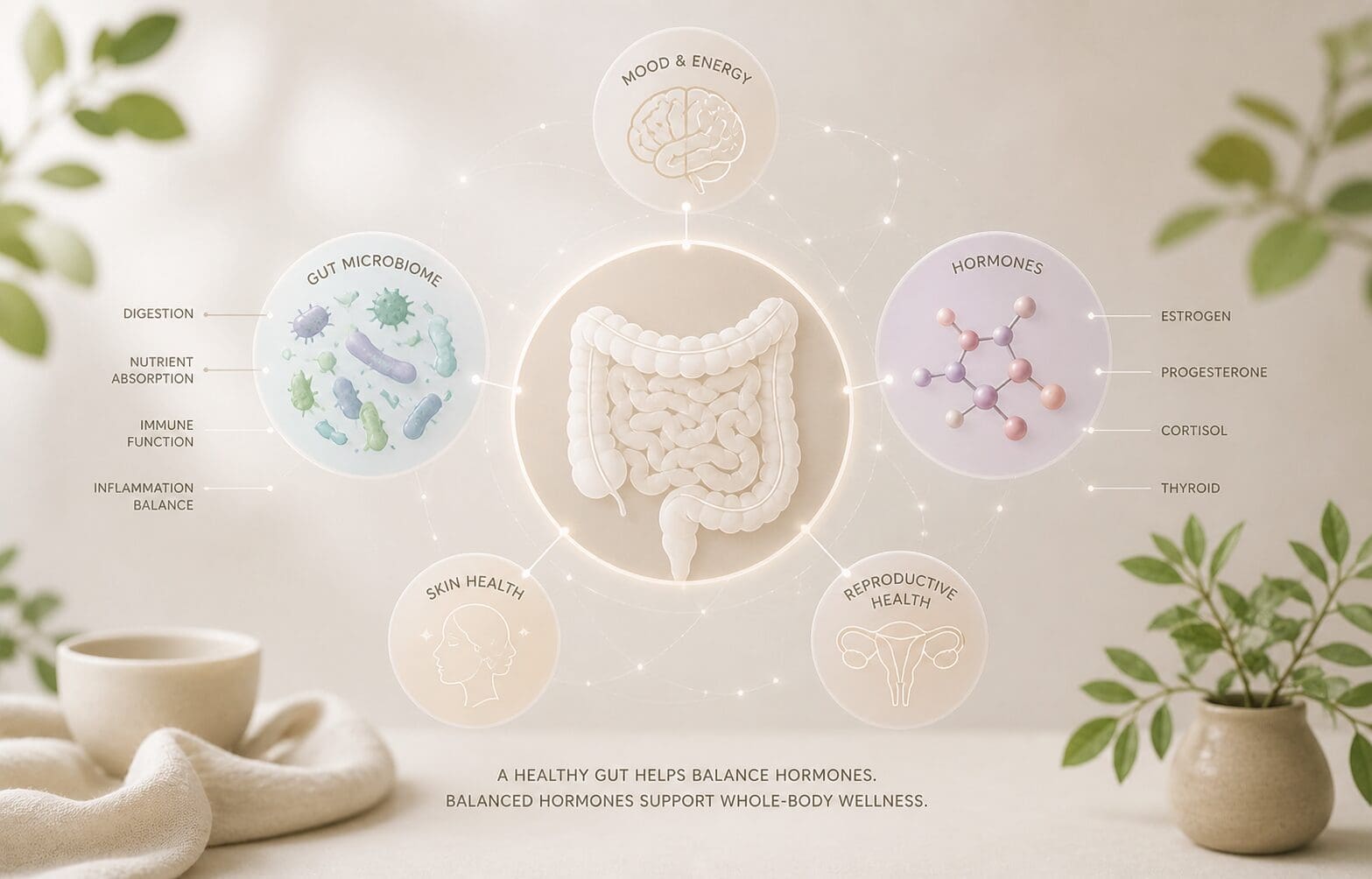 FAQ: What is the connection between gut health and hormone balance?
Gut health plays a critical role in hormone balance because the gut microbiome helps regulate how hormones like estrogen are processed and eliminated. When gut bacteria are imbalanced, hormones can recirculate instead of being cleared, leading to symptoms such as bloating, fatigue, mood swings, and irregular cycles even when blood work appears normal. Supporting gut health through acupuncture, diet, and functional medicine can help restore hormonal balance naturally.
What Is the Estrobolome and Why Does It Matter?
Your gut is not just responsible for digestion. It is one of the most metabolically active systems in the body, playing a central role in regulating hormones, immune function, and inflammation.
There is a specific group of gut bacteria known as the estrobolome that metabolizes estrogen. Under healthy conditions, estrogen is processed in the liver, sent to the gut, and then eliminated from the body. But when the gut microbiome is out of balance, that process becomes disrupted.
Instead of being eliminated, estrogen is reabsorbed and recirculated back into the bloodstream. Clinically, this is where we begin to see patterns like estrogen dominance, worsening PMS, breast tenderness, mood swings, and weight that seems resistant to change.
The Cleveland Clinic has highlighted how gut health directly impacts hormone regulation, immune balance, and inflammation reinforcing what we often see every day in clinical settings.
Signs Your Gut Health Is Affecting Your Hormones
What makes this challenging is that these symptoms rarely show up in isolation. Most women I see are not dealing with just one issue, they are dealing with a pattern.
Digestive symptoms like bloating, constipation, and food sensitivities begin to appear. At the same time, hormonal symptoms layer in. Cycles become more symptomatic. Energy becomes unstable. Skin changes. Mood shifts. Sleep becomes lighter.
Individually, these symptoms may seem unrelated. But when you step back, they often tell the same story.
From a Chinese medicine perspective, this reflects a disruption in the body’s ability to transform, move, and eliminate efficiently. When these systems are not functioning smoothly, the body begins to accumulate what it cannot properly process and that is when symptoms compound.
Common Signs the Gut-Hormone Connection Is Disrupted
- Persistent bloating, gas, or digestive discomfort
- PMS symptoms that have worsened over time
- Irregular or painful menstrual cycles
- Fatigue that doesn’t resolve with rest
- Mood swings, anxiety, or low mood — especially around your cycle
- Stubborn weight gain, particularly around the midsection
- Poor sleep or waking between 1–3am
- Brain fog or difficulty concentrating
- Skin changes like acne or dryness
- Food sensitivities that seem to be increasing
Why Normal Lab Results Don’t Rule Out Hormone Imbalance
FAQ: Why do normal labs not show hormone imbalance?
Standard lab testing is designed to detect disease and not subtle imbalances. This means you can fall within a “normal” reference range and still experience significant symptoms. Functional medicine looks more deeply at gut health, inflammation, hormone metabolism, and microbiome balance to identify disruptions that standard panels are not designed to find.
This is one of the most frustrating experiences for patients. You’re told everything looks fine, but your body is clearly telling you otherwise.
Standard lab reference ranges are broad, built to identify disease states and not early dysfunction or suboptimal function. This means you can be technically “normal” while still feeling significantly off.
This is where a functional medicine approach becomes invaluable. Instead of asking whether something is diagnosable, we begin asking: How well are your systems actually functioning? We look at gut health, microbial balance, inflammation, and how your body is metabolizing hormones in real time.
The National Institutes of Health has published extensive research on the gut microbiome and its role in systemic regulation, including hormonal balance — research that is beginning to reshape how practitioners approach women’s health.
Root Causes of Hormone Imbalance: Gut, Inflammation & Detoxification
When we look beneath the surface, a few key patterns consistently show up in women experiencing hormone imbalance on Long Island and beyond.
1. Microbiome Imbalance (Dysbiosis)
Beneficial bacteria decrease while less helpful strains become more dominant. This directly disrupts how estrogen is metabolized through the estrobolome leading to recirculation and accumulation of estrogen in the bloodstream.
2. Impaired Detoxification Pathways
The body relies heavily on healthy digestion and regular elimination to clear hormones. When these processes slow down, due to constipation, poor liver function, or dysbiosis, hormones are not cleared effectively, building up in circulation.
3. Chronic Inflammation & Intestinal Permeability
When the gut lining becomes compromised, it can trigger systemic immune activation that affects multiple systems simultaneously, including hormone regulation. Research from Harvard Medical School continues to explore how intestinal permeability and chronic inflammation contribute to conditions that overlap with hormone imbalance.
4. Chronic Stress & Cortisol Dysregulation
Chronic stress raises cortisol, which directly suppresses progesterone production and destabilizes blood sugar, both of which worsen hormonal symptoms. The gut-brain axis means that stress directly changes gut bacteria composition, creating a feedback loop that accelerates hormone disruption. For many women navigating high-stress lives, this is often the missing piece.
How Acupuncture and Functional Medicine Support Hormone Balance Naturally

FAQ: Can acupuncture and functional medicine help hormone imbalance naturally?
Yes. Acupuncture supports hormone balance by calming the nervous system, improving gut motility, and reducing systemic inflammation. Functional medicine identifies root causes including microbiome imbalance, impaired detoxification, and poor hormone metabolism that standard labs often miss. Together, these approaches address hormonal symptoms at the source rather than managing them symptom by symptom.
At Healing Points Acupuncture our approach is very intentional. We are not simply trying to “balance hormones,” we are supporting the systems that regulate them.
Acupuncture for Hormone Imbalance
Acupuncture calms the nervous system, improves circulation, reduces cortisol, and supports digestive function. Many patients across Long Island notice that after just a few sessions, they experience a sense of calm and ease that they haven’t felt in a long time which is often an early sign that their nervous system is beginning to regulate.
Chinese Herbal Medicine
Chinese herbal medicine allows us to work on deeper patterns in a way that is precisely tailored to the individual. Formulas are adjusted over time based on your body’s response, making this one of the most personalized tools we have.
Functional Medicine
Functional medicine gives us the clinical tools to identify underlying imbalances in gut health, inflammation, and hormone metabolism so we can customize a treatment plan specifically for you. This may include comprehensive stool testing, organic acid testing, or advanced hormone panels that go well beyond standard bloodwork.
Frequency Specific Microcurrent (FSM)
FSM helps reduce inflammation and support cellular communication and can play a critical role in tissue healing and nervous system regulation. Many patients experience profound relaxation and reduced pain during and after sessions.
When these systems begin to work together again, the body often does what it has been trying to do all along. It rebalances.
How to Support Your Gut for Better Hormone Balance
Healing does not have to begin with a complete overhaul. It often starts with small, consistent shifts that compound over time.
Foods That Support the Estrobolome
The estrobolome thrives on fiber and fermented foods. Prioritizing cruciferous vegetables (broccoli, cauliflower, Brussels sprouts), ground flaxseed, fermented foods like sauerkraut and kimchi, and a wide variety of colorful plant foods gives your gut bacteria what they need to metabolize estrogen efficiently.
Reduce Inflammatory Triggers
Gluten, refined sugar, alcohol, and processed seed oils are among the most common drivers of gut inflammation and dysbiosis. Even a short-term reduction in these foods can create meaningful shifts in how your gut, hormones, and function.
Support Elimination & Detoxification
Daily bowel movements are non-negotiable for healthy estrogen clearance. If you are not eliminating at least once per day, hormones are being reabsorbed. Hydration, fiber, magnesium, and movement all support this process.
Calm the Nervous System Daily
Slowing down while eating, prioritizing 7–9 hours of sleep, and creating moments of genuine rest throughout the day send signals of safety to the body. These are not small things, they are foundational. The gut-brain axis means your nervous system state directly shapes your microbiome.
Consider Targeted Supplementation
Supplements like probiotics (especially Lactobacillus and Bifidobacterium strains), DIM (diindylmethane), calcium-d-glucarate, and magnesium glycinate can support estrogen metabolism and gut health, but they work best when selected based on your specific pattern, not generically. A functional medicine consultation can help identify what your body actually needs.
Gut Health, Hormone Imbalance & Perimenopause on Long Island
For women in perimenopause, which typically begins in the mid-to-late 40s, though sometimes earlier, the gut-hormone connection becomes especially important. As estrogen and progesterone levels naturally fluctuate, an already-imbalanced gut microbiome can dramatically amplify symptoms like hot flashes, night sweats, mood instability, weight gain, and brain fog.
Many women are navigating perimenopause without realizing that gut health is a central lever. When we support the estrobolome during this transition, it can meaningfully ease the process, naturally and without the need to immediately resort to hormone replacement therapy.
If you are in your 40s and beginning to notice changes that feel different from your usual hormonal patterns, this is an important window to address gut health proactively.
Acupuncture for Hormone Imbalance in Riverhead & the Hamptons, NY
If you have been struggling with symptoms that don’t seem to have clear answers and if your labs are normal but your body is telling you something else, it may be time to look at the bigger picture.
At Healing Points Acupuncture & Wellness Center in Riverhead, we see women from across Long Island, the East End, and all of Suffolk County who are ready to stop managing symptoms and start understanding what is actually driving them.
We combine acupuncture, Chinese herbal medicine, functional medicine, and frequency-based therapies to understand what your body is asking for and how best to support it.